
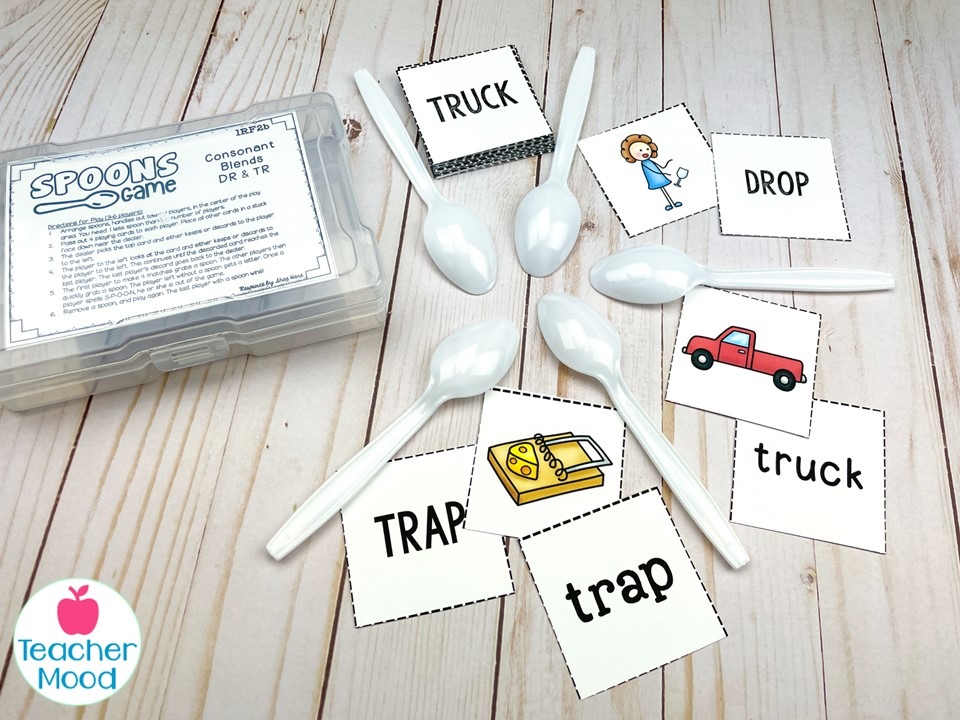

As elementary teachers, we constantly strive to create engaging and academically challenging environments for our students. One especially effective way to achieve this is by incorporating phonics games for our elementary students. Games can transform learning from a mundane task into an exciting adventure, fostering both student engagement and academic growth. Today, I want to introduce you to a game called “Spoons”—but with a phonics twist. This version of Spoons specifically targets phonics skills, providing a fun and interactive way for students to practice essential reading foundations.
Why Use Games in Phonics Instruction?
Before diving into the specifics of the Spoons game, it’s important to understand the benefits of using games in the classroom:
1.
Increased Engagement
Of course, games naturally capture students’ interest and enthusiasm. When students are engaged, they are more likely to participate actively and retain information better.
2.
Motivation to Learn
Games introduce an element of fun and competition, motivating students to challenge themselves and each other. In particular, this motivation can lead to a deeper student engagement in the learning process.

3.
Social Skills Development
Many games require students to interact, collaborate, and communicate, fostering important social skills that are essential for their overall development.
4.
Differentiated Learning
Games can be easily adapted to meet the diverse needs of learners. This flexibility allows teachers to provide appropriate challenges for students at various skill levels.
5.
Immediate Feedback
Games often provide instant feedback, helping students to quickly identify and correct their mistakes, which reinforces learning.

How to Play Phonics “Spoons”
The phonics version of Spoons is similar to the traditional card game, but instead of using a regular deck of cards, you’ll use cards with phonics skills printed on them. Here’s a step-by-step guide to playing the phonics game for elementary students:
Materials Needed:
- A set of phonics cards (these can be homemade or purchased). The cards should feature different phonics elements such as blends, digraphs, and vowel sounds.
- Spoons (one fewer than the number of players).
- A group of 3-6 students.

Objective:
The goal of the game is for players to collect four cards that share a common phonics feature and then grab a spoon from the center of the table. The last player to grab a spoon is out.
Rules:
- Shuffle the phonics cards and deal four cards to each player. Place the spoons in the center of the table.
- Players pick one card from their hand to pass to the left and simultaneously receive a card from the player on their right.
- Players continue to pick and pass cards, trying to collect four cards that feature the same phonics element.
- Once a player collects four matching cards, they discreetly take a spoon from the center.
- Other players continue to pass cards until they notice a spoon has been taken. They then grab a spoon as quickly as possible.
- The player left without a spoon is out. Remove one spoon and continue the game until one player remains. The person who grabs the last spoon is the winner.

Differentiating Phonics “Spoons” for Different Learners
Differentiation is key to ensuring all students benefit from the game, regardless of their skill level.
For Kindergarteners:
- Simplify the Phonics Skills: Use basic phonics skills such as single consonants and short vowel sounds.
- Visual Supports: Include pictures on the cards to help young learners associate phonics sounds with visual cues.
- Modeling and Guided Practice: Initially play the game as a whole class, modeling each step. Provide guided practice with small groups before allowing students to play independently.
- Shorter Game Duration: Keep the game sessions brief to maintain attention and prevent frustration.

With First Graders:
- Moderate Phonics Skills: Use phonics skills such as consonant blends, digraphs, and short vowels in CVC (consonant-vowel-consonant) words.
- Interactive Modeling: Demonstrate the game with a small group of students before having the whole class participate. This ensures that first graders understand the rules and objectives.
- Use of Word Families: Incorporate cards that feature word families (e.g., -at, -an, -ig) to help students recognize patterns and improve their decoding skills.
- Peer Support: Pair stronger readers with those who need more support to foster a collaborative learning environment and ensure that all students can participate successfully.

In Second Grade:
- Advanced Phonics Skills: For older elementary students playing the phonics games, incorporate more complex phonics elements such as vowel teams, r-controlled vowels, diphthongs, and multisyllabic words.
- Peer Teaching: Encourage more proficient students to assist their peers, fostering a collaborative learning environment.
- Strategy Development: Challenge students to develop strategies for identifying and collecting their cards more efficiently.
- Incorporate Writing: After each round, have students write sentences or short stories using the phonics elements they collected, reinforcing their learning through application.

Summing Up Phonics Games for Elementary Students
Incorporating games into phonics instruction for elememtary students not only makes learning more enjoyable but also significantly enhances student engagement and achievement. The phonics version of “Spoons” is an especially versatile and adaptable game that can be tailored to meet the needs of all learners in your classroom. By using this game, you can create an interactive and supportive environment where students are excited to practice and master their phonics skills.
So, give phonics “Spoons” a try in your classroom! You’ll likely find that your students are not only having fun but also making meaningful progress in their phonics development. Happy teaching!

Don’t have the time or patience to make your own card decks?
If you’re a busy teacher who doesn’t have the time to create your own phonics Spoons games, I’ve got you covered! My Spoons Phonics Bundle includes everything you need to get your students practicing foundational phonics skills in a fun, engaging way. From beginning sounds to diphthongs to compound words, these print-cut-and-play sets are ready to use in your classroom—very little prep required! Whether you’re teaching kindergarteners or second graders, this bundle provides differentiated options to fit the needs of your learners. If you don’t need the whole set, the skills can also be purchased in smaller sets. Let your students enjoy phonics practice while you save time and energy!